 Call us :-
+91-8004301267
Call us :-
+91-8004301267 Email: info@drsaurabhjain.co.in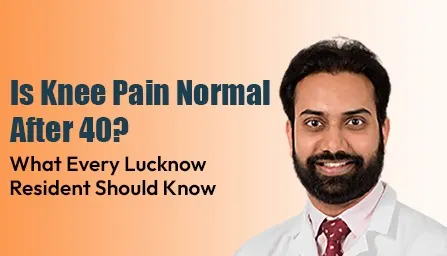
You climb the stairs at Hazratganj. Your knee clicks.
You get up after sitting on the floor during a family function. Something aches.
You walk through the crowded lanes of Aminabad or jog in Janeshwar Mishra Park. By evening, your knees feel heavy and stiff.
Sound familiar?
If you are above 40 and living in Lucknow, you are not alone. Knee pain after 40 is one of the most common complaints that brings patients to an orthopedic doctor in Lucknow. But here is the question most people get wrong — is it normal, or is it a warning sign?
This blog breaks it down simply. No complicated medical terms. Just honest, clear information.
First — There Is a Difference Between "Common" and "Normal"
This is the most important thing to understand.
Knee pain after 40 is extremely common. But that does not make it normal in the medical sense. Many conditions that people dismiss as "age-related" are actually treatable — sometimes without surgery at all.
Ignoring knee pain for months or years is one of the biggest mistakes patients make. By the time they visit a specialist, the joint damage is often far more advanced than it needed to be.
Mild, occasional soreness after intense physical activity can be normal. But persistent pain, swelling, stiffness, or a feeling of instability in the knee — these are signals your body is sending you for a reason.
Why Does Knee Pain Happen After 40?
Your knee is the largest and most complex joint in your body. It absorbs enormous pressure every single day — from walking, climbing stairs, sitting cross-legged, and carrying your own body weight.
After 40, several things begin to change inside the joint:
- Cartilage starts thinning. The cushion between your bones wears down gradually. This is the beginning of osteoarthritis.
- Muscles around the knee weaken. Less muscle support means more load falls directly on the joint.
- Ligaments lose elasticity. Minor movements that never bothered you before can now cause small tears or strains.
- Fluid in the joint decreases. This fluid lubricates the joint. Less of it means more friction and stiffness.
- Old injuries resurface. A sports injury from your 20s — a ligament strain or a meniscus issue — can start causing symptoms again after 40.
None of this happens overnight. It builds slowly. Which is exactly why most people miss the early signs.
Lucknow's Lifestyle Makes It Worse — Here's How
Living in Lucknow adds specific factors that accelerate knee wear after 40. These are not talked about enough.
Sitting on the floor is a cultural habit. From namaz to family gatherings to eating on dastarkhwan — floor sitting is a regular part of life here. Deep knee bending repeatedly over years puts significant pressure on the joint cartilage.
The climate plays a role. Lucknow's humidity — especially during monsoon — causes joint inflammation in many people. Cold winter mornings in December and January can make stiffness significantly worse. Many patients report their worst pain between November and February.
Long commutes and uneven roads. Whether you're on a two-wheeler navigating Alambagh or walking on uneven pavements in Chowk, your knees absorb the constant impact. This adds up over years.
Sedentary desk jobs are rising. IT professionals, teachers, and government employees in Lucknow spend long hours sitting. Weak quadriceps from inactivity are one of the leading causes of knee pain in people between 40–55.
Late seeking of medical advice. In Lucknow's culture — like much of north India — people tend to manage pain with home remedies, hot water bags, and painkillers for far too long before visiting a specialist. This delay often makes the condition harder to treat.
Is your knee pain stopping you from living fully? Dr. Saurabh Jain at Health City Vistaar, Lucknow offers expert evaluation and honest advice — surgical or non-surgical. Call now: +91-8004301267
A Patient's Story — From Denial to Recovery
Shared with patient's consent.
Ramesh Verma, 47, a school principal from Indira Nagar, had been managing right knee pain for almost two years. He assumed it was age and continued his routine — teaching, walking to school, and occasionally playing badminton on weekends.
By late 2023, the pain had started disturbing his sleep. Walking up two flights of stairs at school had become a daily struggle.
When he finally visited Dr. Saurabh Jain at Health City Vistaar, the MRI showed moderate medial compartment osteoarthritis — a condition that had likely been developing for years.
The good news: surgery was not needed. Dr. Jain recommended a structured physiotherapy plan, specific knee-strengthening exercises, dietary changes, and a viscosupplementation injection. Within 10 weeks, Ramesh's pain had significantly reduced. He was back on the badminton court — carefully — within four months.
"I wasted two years thinking this was normal aging. I wish I had come earlier," he said.
This is not an isolated case. Many patients at Dr. Jain's clinic comes in late — but early intervention almost always leads to better outcomes.
Warning Signs That Mean You Should NOT Wait
Occasional stiffness in the morning is one thing. But the following signs need a proper medical evaluation — as soon as possible:
- Pain that wakes you up at night
- Swelling around the knee that doesn't go down
- A feeling that your knee might "give way" suddenly
- A clicking or locking sensation during movement
- Knee pain that has lasted more than 4–6 weeks continuously
- Pain that is getting progressively worse, not better
- Difficulty straightening or fully bending the knee
- Any visible deformity or change in leg alignment
If you recognise even two or three of these — do not wait.
Don't ignore what your knee is telling you. Book a consultation with Dr. Saurabh Jain — Lucknow's trusted arthroscopic and sports injury specialist. WhatsApp / Call: +91-8004301267
What Can Actually Help — Realistic Options
Here is what modern orthopedic care offers for knee pain after 40. The right option depends on your specific diagnosis.
Non-Surgical Options (Most patients start here):
- Targeted physiotherapy and muscle strengthening
- Anti-inflammatory medication (short-term, supervised)
- Viscosupplementation injections (lubricating the joint)
- PRP therapy (Platelet-Rich Plasma) for cartilage support
- Lifestyle modifications — weight, activity, footwear
- Bracing and orthotics for alignment correction
Surgical Options (Only when needed):
Arthroscopic knee surgery — minimally invasive, small cuts, faster recovery
- High Tibial Osteotomy (HTO) — for younger patients with early arthritis
- Partial or Total Knee Replacement — for advanced arthritis where joint is significantly damaged
The important thing to know: surgery is not the default. Most patients — especially those who come in early — are managed very effectively without it.
When Should You See an Orthopedic Doctor in Lucknow?
The honest answer — sooner than you think.
If you are above 40 and your knee pain has lasted more than a month, an evaluation makes complete sense. An X-ray and a physical examination can tell you a great deal. An MRI may be needed depending on what the doctor finds.
Early diagnosis does not always mean treatment. Sometimes it simply means knowing exactly where you stand — and what to watch for.
Dr. Saurabh Jain at Health City Vistaar, Lucknow specialises in arthroscopic surgery and sports injuries and takes a strongly evidence-based, non-surgical-first approach to orthopedic care. Every patient gets a thorough diagnosis, honest explanation, and a treatment plan that fits their lifestyle and goals — not a one-size-fits-all protocol.
Ready to understand your knee pain properly? Visit Dr. Saurabh Jain at Super Speciality Hospital, Sector 4, Health City Vistaar, Lucknow. Serving patients from Indira Nagar, Gomti Nagar, Hazratganj, Aliganj, Vikas Nagar & beyond. 📞 +91-8004301267 | info@drsaurabhjain.co.in
Disclaimer: This blog is intended for general informational purposes only and does not constitute medical advice. The content shared here should not be used as a substitute for professional medical consultation, diagnosis, or treatment. Knee pain can arise from a wide variety of causes, and individual cases vary significantly. Please consult a qualified orthopedic specialist for an accurate diagnosis and personalised treatment plan. Dr. Saurabh Jain and his clinic do not make any curative or outcome guarantees. Results may vary from patient to patient depending on the nature and severity of the condition.
